Compelling headline to draw in your ideal client.

Empowerment and Growth Await with [Your Name].
Include a next step... Begin Your Journey Today.
WELCOME TO IN CHARGE IN CHANGE
You've already done the hardest thing. Now it's time to do the next one — reclaim your home, understand your finances, and build a life that actually feels like yours.
I help single, divorced, and widowed women — stabilize their nervous system, reclaim their identity, and build an exciting new future by taking back the two things that keep them most stuck: their home and their finances.
Mini-Series → RECLAIMED Framework (which includes Home to Healed & Ledger Reclaimed bundled).
Start where you are. Go as far as you're ready.
A PERSONAL WELCOME FROM ME TO YOU
Hi — I'm so glad you're here.
Before you explore, I'd love for you to hear a little about who I am and why I built this — in my own words.

YOU ARE NOT ALONE
The life you had is gone. The life you're building hasn't quite arrived yet. Right now, you're somewhere in between.
Maybe his coffee mug is still in the cabinet and you can't bring yourself to move it. Maybe you've done the therapy, read the books, tried the journaling — and you still wake up at 3am doing mental arithmetic you don't trust, in a home that still feels like a museum to your old life.
Or maybe you run a business that used to have a financial safety net underneath it — and that net is gone, and the books are three months behind, and you don't know where to begin.
You are not behind. You are not broken. You are a capable woman facing enormous change — and you deserve someone in your corner who can help carry the financial weight while you rebuild everything else.
THREE WAYS IN. ONE JOURNEY FORWARD
Start where you are. Go as far as you're ready.
MINI-SERIES
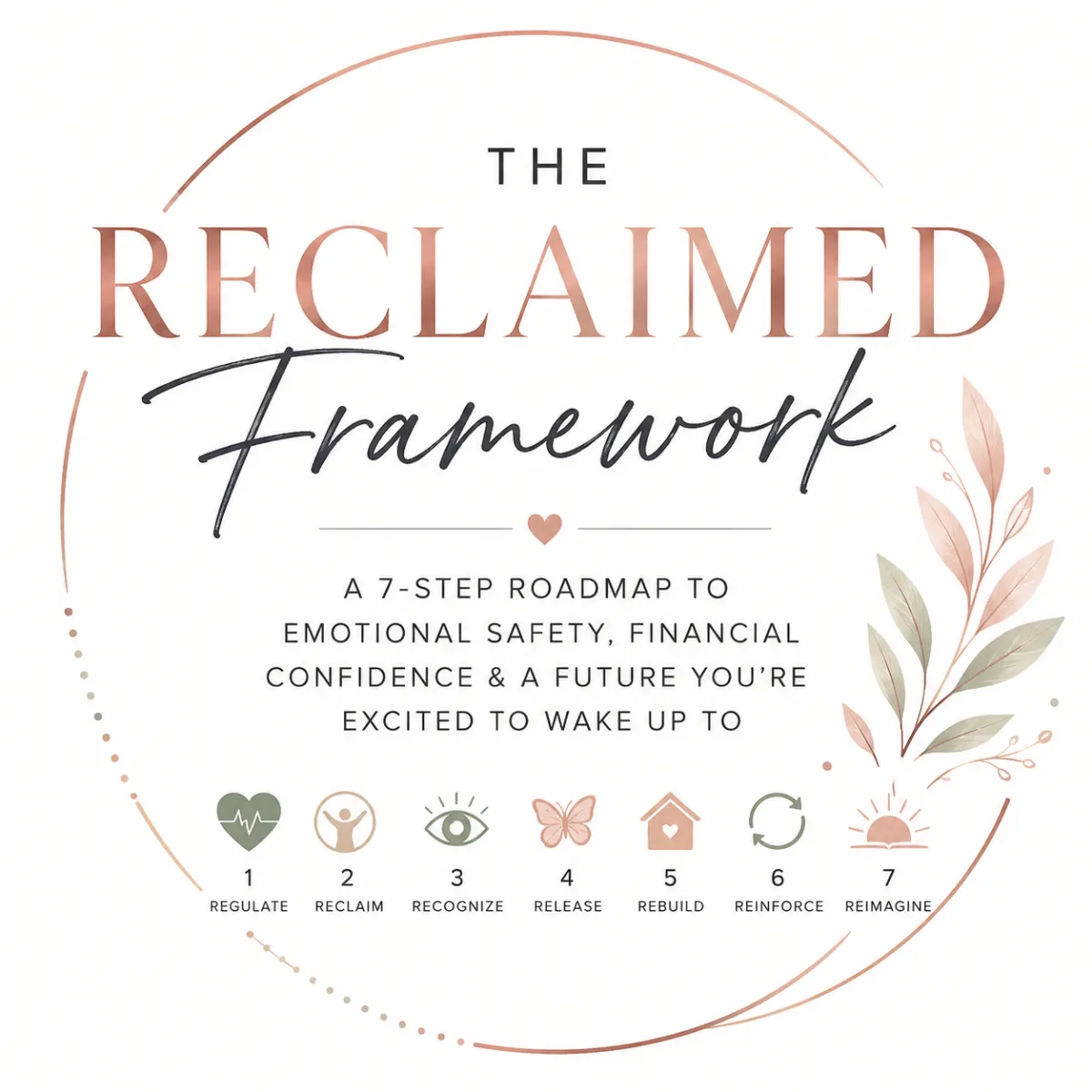
RECLAIMED
Five videos introducing the RECLAIMED Framework — your first step into safety, identity, and financial confidence after loss. Start here, at your own pace, before you're ready for more.
Feeling at peace in your home again
Becoming the woman you can rely on
Creating a life you're excited to wake up to
Introduction to the full RECLAIMED Framework
Bonus: Financial peace & freedom
12 WEEK COACHING PROGRAM & COURSE
Home To Healed
Your home became a museum of your former relationship. Until that changes, your healing stays incomplete. This 12-week program helps you regulate your nervous system, rediscover your identity, and transform your home into a space that belongs entirely to you.
Nervous system stabilization — why your body still feels unsafe
Identity reclaiming — who you are now that it's just you
Room-by-room home transformation, guided and supported
2 private coaching calls per week + between-session support for 12 weeks
Lifetime access to the course
For divorced, separated, and widowed women
MONTHLY MEMBERSHIP
The Ledger Reclaimed
Monthly financial clarity membership. Education, tools, live Q&A calls, and community so you never have to manage your money alone again.
Foundation modules — From Financial Panic to Financial Clarity
Financial literacy mini-series in plain English
Tools, worksheets, and templates you'll actually use
Monthly live Q&A with Leah — your questions answered
Private member community — women who get it
Monthly content drop
Optional 1:1 bookkeeping add-on for members who want it
WHO I HELP
This is for you if...
HEART
You are newly divorced, separated, or widowed — and you feel like a stranger to yourself and your own life
HOME
Your home still feels like a museum of your former relationship — and every room tells a story you're trying to move on from
MONEY
Managing your finances alone — on top of grief, on top of rebuilding, on top of everything else — is its own kind of overwhelming. You shouldn't have to carry that without support.
REAL WOMEN. REAL WORDS
What it sounds like on the other side
"After my divorce I avoided my own living room for months — I didn't even realize I was doing it until Leah pointed it out. She helped me understand that the room was still set up for a life that no longer existed. One weekend, one reading chair, one candle that was just mine. Now it's the room I crave at the end of every day. My body actually exhales when I walk in."
— Sarah M, coaching client
"I didn't know my own credit score. I had a pile of statements I hadn't opened in three months. Leah sat with me through every single one without making me feel stupid for a second. For the first time since my divorce, I actually know where I stand."
— Jennifer R., The Ledger Reclaimed member
"She gets it in a way that no one else in my life does — not the grief, not the practical chaos, not what it feels like to run a business while your whole life is falling apart. I've never felt so understood and so supported at the same time."
— Michelle T., coaching + membership
BEFORE YOU CLOSE THIS TAB
I know what you're thinking right now. Let me answer it honestly.
"I should be able to figure this out on my own."
You are not someone who struggles with hard things. You have managed a career, a household, possibly children and a business — all at once. But now you are doing all of it while also grieving, rebuilding, and figuring out who you are on the other side of a major loss. Nobody should have to do that without support. You don't need to figure it out alone. That's why this exists.
"I've tried therapy, courses, purging everything — or holding on to all of it. Nothing works."
Because everything you've tried addressed one piece of the picture — not the whole thing. Therapy talks about the feelings without changing the physical space. Courses give you information without implementation support. Purging without a framework, or holding on without understanding why — both are coping responses without a real strategy. This work addresses the specific connection between your environment, your nervous system, and your identity that everything else leaves out.
"I'm embarrassed by the state of my finances. I can't let anyone see that."
I have sat with women who didn't know the password to their own bank account. Women who hadn't opened a statement in months. Women who found out about debt they didn't know existed after their partner died. You will not be the most chaotic situation I have encountered. And even if you were — it would change nothing about how I show up for you. You come as you are. Always.
"I'm not sure I'm ready."
Most of the women I work with said exactly that before they reached out. Waiting until you feel ready is often another way of staying in the pain — because the readiness doesn't come from the inside. It comes from having the right support on the outside. The discovery call is free. There is no pressure. Let's just have a conversation and figure out if this is the right fit.
"Making changes to my home feels too final. Like I'm erasing something."
That fear is completely respected here. Nothing in this work forces you to let go before you are ready. The program creates safety so that release can happen naturally — without guilt, without pressure, at your own pace. We never move faster than you can. And many women find that the smallest changes — one pillow, one nightstand — create the biggest shifts, without losing anything that matters.
"I've spent money on things that didn't work. What makes this different?"
Most financial education is generic — written for someone else's life, not yours. The Ledger Reclaimed is built specifically for newly single women. Every module, every tool, every conversation inside the membership starts from where you actually are. And every month there is a live call where you can ask your specific questions and get a real answer — not a workbook and a wish of good luck.
FROM THE BLOG
Want to learn more before you dive in?
Start here. These three posts were written for exactly where you are right now.
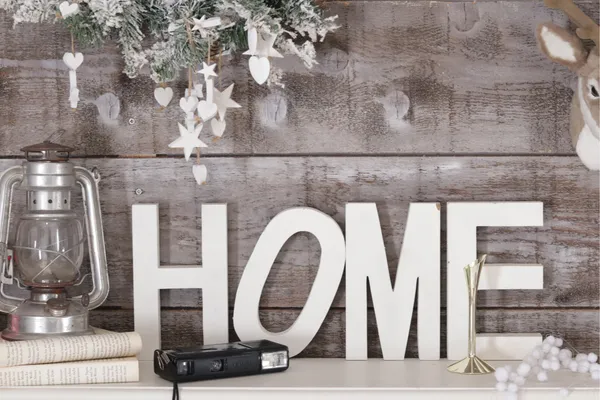
Why Your Home Still Doesn't Feel Like Yours (And What's Really Going On)
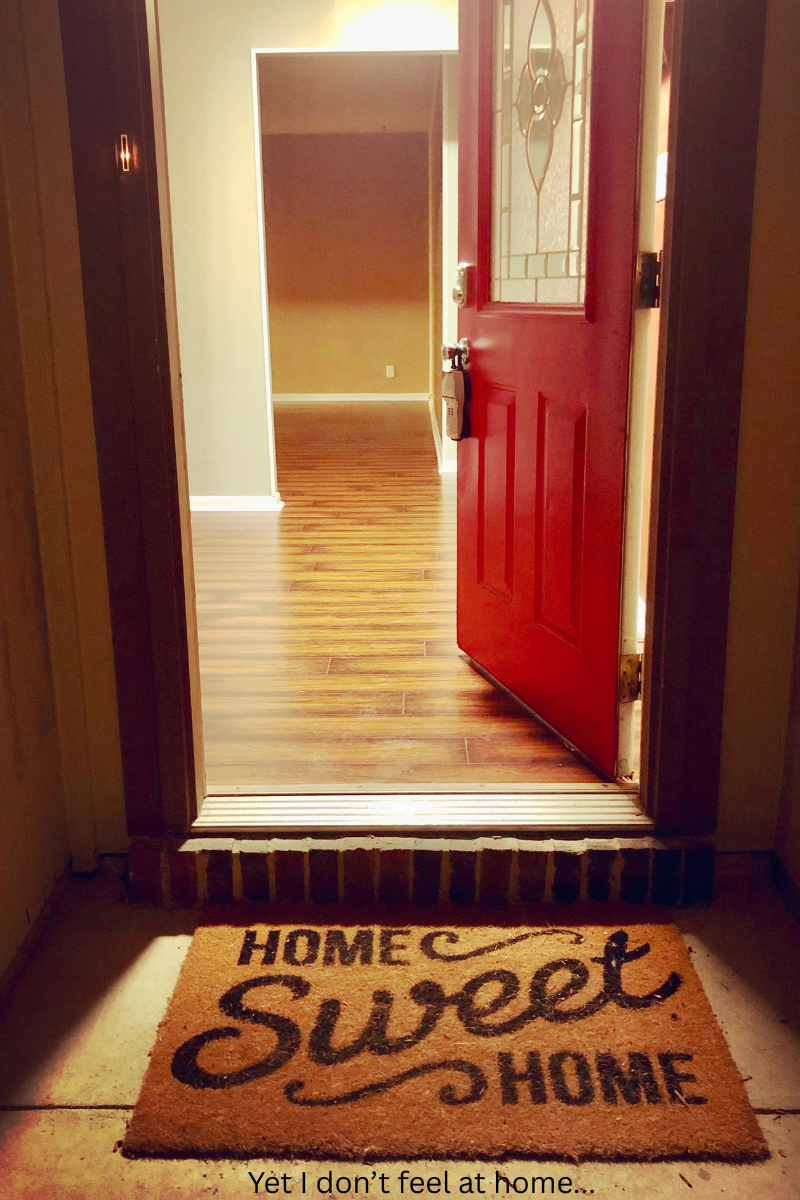
You've been living in this home — maybe for months, maybe for years since your loss. You've cleaned it. You've organized it. You may have even bought new things for it. And yet, when you walk through the front door, something still doesn't feel right. It doesn't feel likeyours.
If you've experienced this, you are not imagining it. And it is not a sign that something is wrong with you. It is a sign that your home is still holding something that needs to be addressed — and that the approach you've tried so far hasn't reached the root of it.
Your home is not just a physical space. It is an emotional one. And when a relationship ends, or a partner dies, the emotional landscape of your home doesn't update automatically.
The Real Reason Your Home Doesn't Feel Like Yours
Most people assume that the way to reclaim a home is to change the physical things in it — paint a wall, move some furniture, donate boxes to charity. And while those actions can be meaningful parts of the process, they are rarely the beginning of it. They are the middle, or even the end.
The beginning is understanding what your home is actually holding. Every space carries emotional energy. The couch where you used to sit together. The side of the bed that was his. The kitchen where you made Sunday breakfasts for a life that no longer exists. These are not just objects and locations. They are anchors — and they anchor you to a version of yourself that you are no longer living as.
Until you understand the emotional charge that each room carries, and until you work through that charge intentionally, no amount of redecorating will make your home feel like yours. You will change the things, but not the feeling. And the feeling is what you are actually trying to change.
The Two Most Common Coping Responses — And Why Neither One Works Alone
When women are going through major loss, there are typically two emotional responses to the home: purging, and holding on.
The Purger
The purger needs things gone. She donates bags and boxes. She clears out closets. She removes every visible trace of the relationship because the sight of it is too painful. This response makes complete sense — and it can feel enormously relieving in the short term. But purging without intention often leads to regret, and it rarely resolves the emotional weight of the space. You can empty every drawer and still feel him in the room.
The Holder
The holder cannot release anything. She walks around objects, avoids rooms, keeps things exactly as they were because changing them feels like a betrayal or a finality she is not ready for. This too makes complete sense. But staying in a home that is preserved like a museum keeps your nervous system in a state of unresolved grief — surrounded by evidence of a life that is over, with no signal that a new one has begun.
Neither response is wrong. Both are attempts to cope with something that is genuinely difficult. But both, without a framework and intention behind them, leave you stuck in the same place: a home that belongs to the past rather than the present.
What Actually Works
What works is a process — not a weekend project. It involves understanding the emotional charge that each space holds before you touch it. It involves knowing your own attachment patterns: why certain objects feel impossible to release, and what they represent beyond their physical form. It involves making decisions about your home from a place of identity rather than fear — asking not "should I keep this?" but "does this belong in the life I am building?"
This is the work at the heart of the Home to Healed Roadmap. Not decoration. Not decluttering. Transformation — from the inside out, one room at a time, in an order that honors how healing actually happens.
Your home can become the first place where your new life is visible. But it takes more than moving things around. It takes intention. It takes support. And it takes someone who understands that the work is emotional as much as it is physical.
If you are ready to begin, I would love to talk with you.

About [Your Name or Business]

Your Paragraph text goes Lorem ipsum dolor sit amet, consectetur adipisicing elit. Autem dolore, alias, numquam enim ab voluptate id quam harum ducimus cupiditate similique quisquam et deserunt, recusandae. here
Join the Community

We'd love to have you. Lorem ipsum dolor sit amet, consectetur adipisicing elit. Autem dolore, alias, numquam enim ab voluptate id quam harum ducimus cupiditate similique quisquam et deserunt, recusandae. here
In Charge In Change


